
The sea lavender of Quatre Pilans: known, but protected enough?
The Generalitat records an area of Limonium tournefortii there with confirmed presence. At the same time, the final Torreblanca plan replaces the public protection system planned for Limonium catalaunicum. Two separate issues that call for a specific answer.
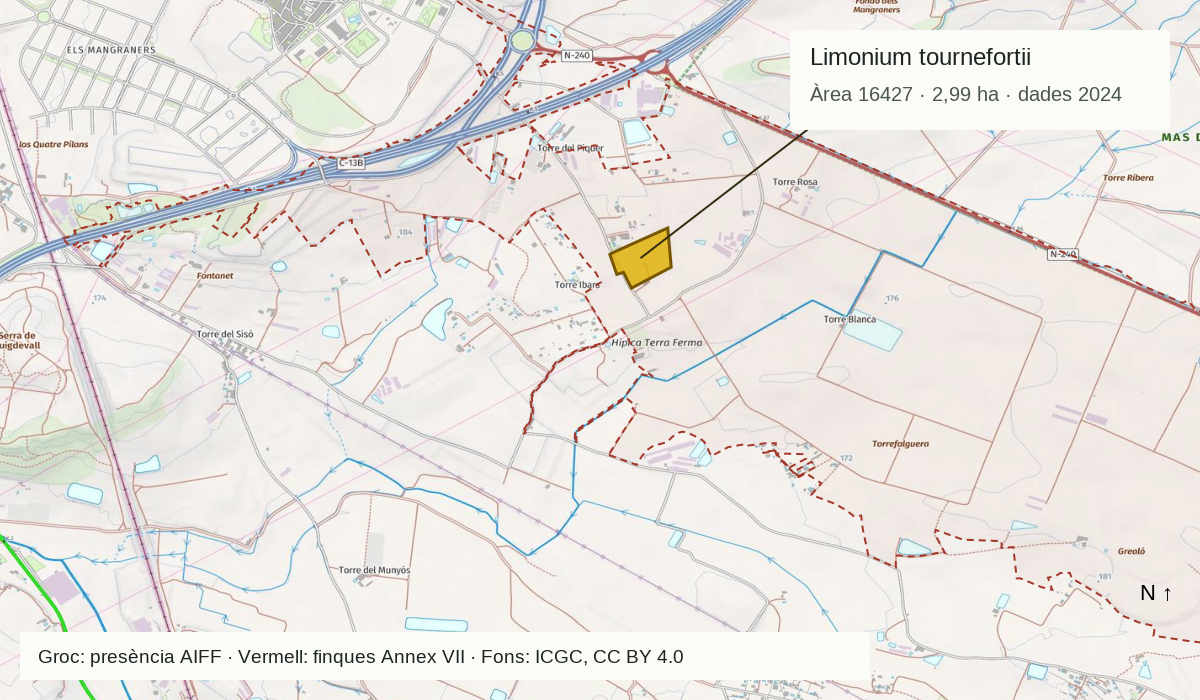
- 2.99 ha
- recorded area of presence of L. tournefortii
- 2024
- year of the AIFF record data
- 10.2 ha
- floral protection system planned in the initial 2022 plan
Translated from the Catalan original. In case of discrepancy, the Catalan version prevails.
In Quatre Pilans, the value of the land also lies in plants that can go unnoticed. Before this area is transformed by the Torreblanca estate, we need to know what lives there, how the planning affects it and who will guarantee its conservation.
We are not starting from a suspicion. The Generalitat's public register of Areas of faunal and floral interest (AIFF) identifies area 16427 under the name Limonium tournefortii. The record states confirmed presence, field observation, native population and 2024 data. The category given is vulnerable. [1]
What does an area of presence mean?
The mapped polygon covers roughly 2.99 hectares. That does not mean the whole area is covered with plants, nor does it tell us how many specimens there are. Nor is it, in itself, a planning reserve. It is a delimitation of presence that provides concrete evidence and must be checked against the planning and an up-to-date botanical survey.
The date of the record matters: the data are from 2024, before the final approval of the PDU on 24 March 2026. It needs to be explained how these data were taken into account and what measures protect this population.
- Species
- Limonium tournefortii
- Area
- 16427 · confirmed presence
- Data origin
- Field observation
- Population
- Native
- Year of data
- 2024
- Recorded category
- Vulnerable
Where is the recorded area?
Two complementary maps: the location within the plots as a whole, and the detail of the area of presence.
1. Location and plots in the plan
Topographic base map. The red lines are the cadastral plots in Annex VII.
2. Detail of the presence
Loading map data…
How it was made: AIFF area 16427; cadastral geometry of plots 1–87 in Annex VII; district boundaries drawn by the association from the municipal KML. Overlap with plots in the plan does not replace checking the exact planning boundary. The 2.99 ha of presence and the 10.2 ha of the 2022 system refer to different areas and concepts: they cannot be subtracted or equated.
Two species, two issues to resolve
Limonium tournefortii should not be confused with Limonium catalaunicum, which also appears in the plan documents. The Generalitat lists the former as vulnerable and the latter as endangered. [2] An answer that refers to catalaunicum does not, on its own, explain how tournefortii is conserved.
The botanical value of the area has been known for years. The 2008 preliminary environmental report for Torreblanca–Quatre Pilans identified a plant there under the name Limonium catalanicum var. procerum. We reproduce the name used in that document as a documentary precedent, without automatically equating that citation with the current record of L. tournefortii. [3]
A warning that needs its own answer
According to the document review published by the association in the Torreblanca section, a 2022 objection warned of the presence of Limonium tournefortii, mainly in Quatre Pilans. The response referred to Limonium catalaunicum, and the flora analysis in the environmental study did not mention tournefortii. [4]
This is the question we are asking to be clarified: where is the impact on the recorded population assessed, and where are the measures to preserve it set out? The mapping data alone do not allow us to state that the population will be destroyed. They do justify demanding a specific answer before any work is done on the land.
From public system to natural interest zone
For Limonium catalaunicum, the plan given initial approval in 2022 provided for a 10.2-hectare floral protection system. Article 26 gave it the status of an urban planning system to guarantee the reproduction of the species and required the land to be publicly owned and used. The screenshot shows the express provision. [5]
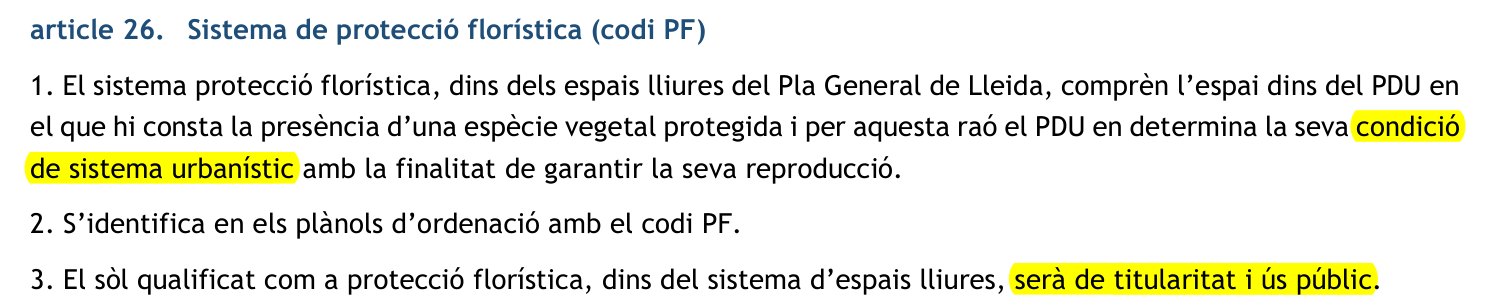
The comparison of the 2022 and 2026 documents published by the association records an important change: the system gives way to a zone of areas of natural interest. The final text provides for conservation measures, but this designation does not require the land to become publicly owned. The same comparison notes that the action area devoted to recovering the sea lavender now refers to wildlife crossings. [5]
Floral protection system
10.2 ha. Express provision for public ownership and use. Purpose of guaranteeing the reproduction of the species.
Zone of areas of natural interest
Conservation provisions remain, but the status of a system and the associated requirement of public ownership disappear.
Fewer public guarantees does not mean no protection
The scope of the criticism needs to be explained properly. The legal protection of a species and the planning designation of the land are different instruments. The change of designation does not mean that the plant is no longer protected, nor that any action on its habitat becomes acceptable.
What is lost, compared with the initial plan, is the provision for a specific public system. As an association, we believe this weakens the guarantees of conservation. A designation on a map needs effective management: people responsible, resources, monitoring and the capacity to correct impacts.
The presence is already documented. Now it must be specified how it will be protected.
What we ask for before the land is transformed
- An up-to-date botanical survey that identifies the species, delimits the populations and assesses their condition.
- An express answer on Limonium tournefortii: how the 2024 AIFF data have been incorporated and how the approved planning affects it.
- Verifiable conservation guarantees, with people responsible, funding, a timetable and public monitoring.
- Restoring the public floral protection system initially planned for Limonium catalaunicum.
The heritage of Quatre Pilans includes what can be seen with the naked eye and what can only be recognised when the land is studied. Threatened flora is part of that heritage. Its conservation must be settled before the transformation of the land compromises its future.
Associació de Veïns de l’Horta Sud de Lleida
Sources to check the data
- AIFF register, area 16427. Generalitat de Catalunya. 2024 data; consulted on the Hipermapa on 27/09/2026, according to the association's records. Original KML file and geometry used in the map.
- Species categories. Generalitat environmental document, with the list of threatened flora. It is used to check the categories, not as evidence of location in Quatre Pilans.
- 2008 precedent. Preliminary environmental sustainability report for the amendment of the Lleida General Plan in the Torreblanca–Quatre Pilans area, vegetation section, «Prats».
- Presence and documentary treatment. The association's review in the Torreblanca section, based on Annex VII, the Strategic environmental study (report, pp. 38–39), the Summary document and the Public participation report of the March 2026 PDU.
- Planning comparison. «Four years to make it worse», sea lavender section, and the screenshot of article 26 of 2022 kept by the association. The account of the 2026 change is based on this documentary comparison.
Base mapping: ICGC, CC BY 4.0. Maps made with the website's materials. The mapping represents the available record, not a botanical census carried out in 2026. No location is attributed to L. catalaunicum that the mapping data used do not document.