Four years to make it worse
We have set the plan put out to the public in 2022 side by side with the one approved in 2026. It is slightly smaller, but almost everything that matters to residents has got worse.
Translated from the Catalan original. In case of discrepancy, the Catalan version prevails.
In July 2022 the Urban Master Plan for Economic Activity in the Plana de Lleida, the plan for the Torreblanca–Quatre Pilans estate, received initial approval and was put out to public consultation. The association submitted objections. On 24 March 2026 the Catalan Territorial Commission gave it final approval, and the DOGC published it on 4 September.
We compared the two documents article by article. The plan is slightly smaller: developable land goes from 351 to 329 hectares. But risk, who pays, the protection of Limonium, climate, access and the intermodal terminal have all got worse. And none of these changes was put out to the public again.
- 261 ha
- that were to be expropriated in 2022 and now go through cooperation: the landowners pay for the works
- 10.2 ha
- of public protection for Limonium that disappear
- 2
- climate offsetting articles deleted
- 1 access road
- for 34,224 daily trips: the N-240 gateway disappears
Seveso activities: from banned to allowed across the whole sector
In 2022 the regulations separated two zones. For the large-plot zone they said, without qualification: «No s'admetran les activitats conegudes com SEVESO» [Activities known as SEVESO will not be allowed], meaning those that handle dangerous substances and carry a risk of major accidents. They were only allowed in the giga-plot, with the measures required by law.

In 2026 this sentence has disappeared. The approved regulations no longer distinguish between zones and do not exclude Seveso activities anywhere in the sector, 420 metres from the Mangraners school and with homes inside and around the estate. We explain it in more detail in Air and fog.
Risk and pollution, left to each company
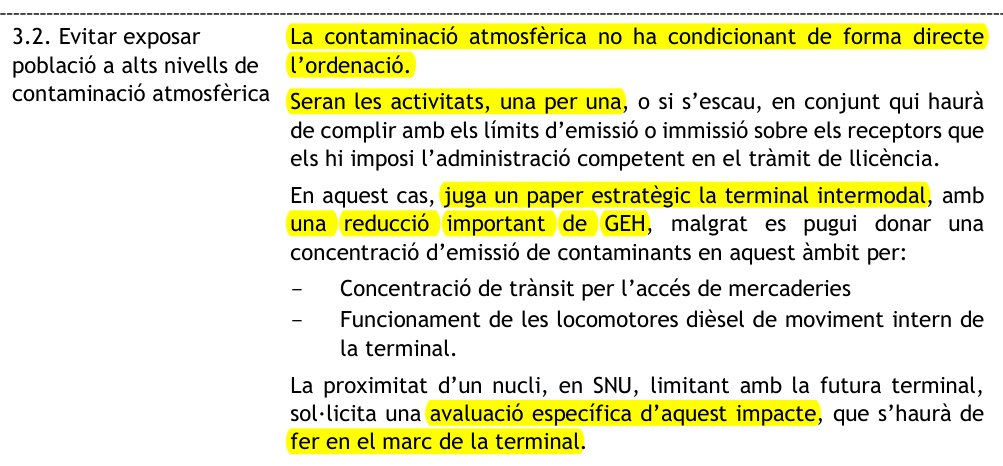
The plan has not studied where pollution from the estate would go. There is no modelling of air dispersion, only of noise. The environmental assessment says it plainly: air pollution «no ha condicionant de forma directe l'ordenació» [has not directly shaped the planning], and it will be «les activitats, una per una» [the activities, one by one] that must meet the limits when they apply for a licence.
The same goes for the risk of major accidents. The regulations say that activities with dangerous substances must be located at the distances set by Civil Protection and Industrial Safety «fruit de l'anàlisi específic de la determinada activitat» [as a result of the specific analysis of each particular activity]. In other words, company by company, once it has already bought the plot. The scoping document for the environmental assessment asked for the maximum industrial safety strip of the estate to be defined, and the approved plan does not draw it.

And all this on a plain where fog leaves the air still for days. Using data from the Femosa weather station, on foggy days the wind blows below 1.5 m/s 81 % of the time. These are the conditions that risk analyses use as the worst case. In Air and fog you can see where the air from the estate would go on the worst days.
Safety distances must be decided when land is planned, not when a company has already bought the plot.
Who pays: from expropriation to cooperation
In 2022 the plan had four sectors and two management systems. The Porta (41.6 hectares) and Torreblanca (219.8 hectares) sectors were to be implemented through expropriation. The regulations justified it like this: «Atès el caràcter d'utilitat pública d'aquest sector, aquest s'executarà per expropiació» [Given the public-utility nature of this sector, it will be implemented through expropriation]. Only the Quatre Pilans sector went through cooperation.

In 2026 there is a single sector of 328.6 hectares, and everything goes through reparcelling under the cooperation system. The difference is huge. With expropriation, the owner receives fair compensation and is out of the operation. With cooperation, the owner hands over the land for streets and green areas free of charge, pays their share of the development works and receives a resulting plot.
In addition, in 2022 the economic document stated how costs were shared: 75 % for the Torreblanca sector and 25 % for Quatre Pilans. In 2026 this rule disappears. The cost table warns that it is an estimate «a manca de que es formalitzi el conveni» [pending the formalisation of the agreement] between Incasòl and the promoters of the intermodal terminal. Today no landowner can know what they will have to pay.
Landowners in the Torreblanca sector could not object to cooperation, because in 2022 it did not exist. If you have land in the estate, on the Torreblanca page we explain what changes and what you can do.
Limonium loses public protection
Limonium catalaunicum is a protected plant that grows within the plan area. In 2022 the plan created a floral protection system to guarantee its reproduction: 10.2 hectares that were to be «de titularitat i ús públic» [publicly owned and used]. There was also an action area devoted to its recovery.
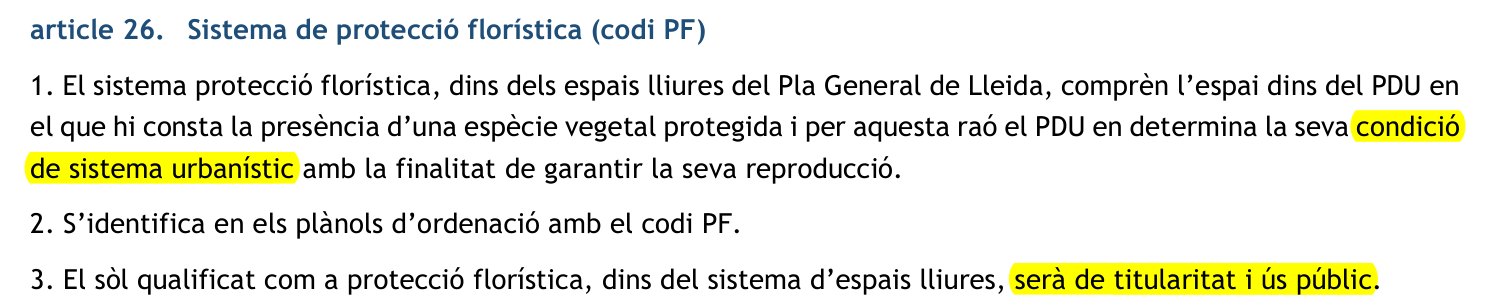
In 2026 this system no longer exists. The land becomes a zone of areas of natural interest, a designation that does not require the land to pass into public hands. The new text refers to conservation measures, but the land stays in private hands. And the Limonium recovery area has become an area for wildlife crossings.
Climate: the offsets are erased
In 2022 the regulations had two articles requiring the climate impact of the estate to be offset. Article 131 required the carbon stock and sequestration of the transformed soils to be offset. Article 138 required the CO2 emissions balance to be calculated and the unavoidable emissions to be offset.
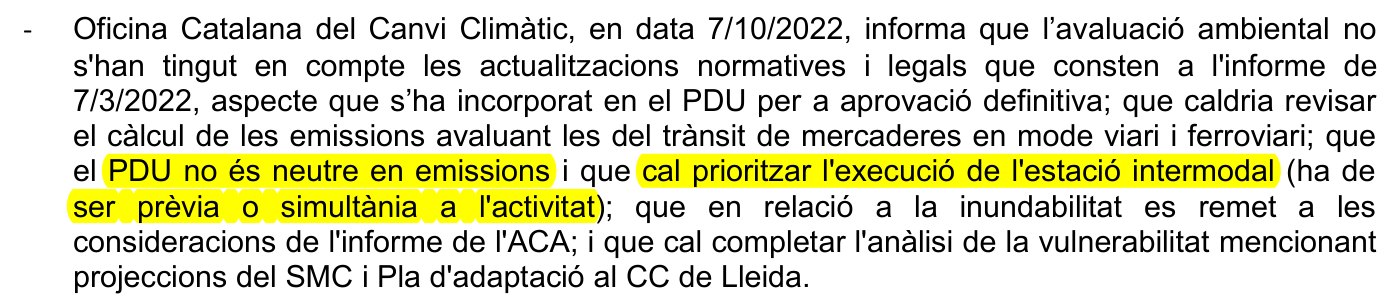
The Catalan Office for Climate Change warned that «el PDU no és neutre en emissions» [the PDU is not emissions-neutral] and that the calculation had to be revised to include freight traffic by road and rail. The response has been to delete both articles.
The mobility manager also disappears. Article 134 of 2022 provided for a body to organise and monitor how the estate's workers would travel, under the supervision of the environmental monitoring committee. In 2026 there is no trace of it.
A single way in
In 2022 the regulations sought to «garantir l'accés al sector per la porta emplaçada sobre la N-240» [guarantee access to the sector through the gateway located on the N-240]. The estate was to have two entrances: one from the C-13B and another from the N-240. In 2026 the N-240 access is gone, and all traffic enters via the C-13B.
The mobility study, however, has barely changed. In 2022 it calculated 34,771 daily trips; in 2026, 34,224. The target of 15 % by public transport is the same. The same numbers and the same measures, with one access fewer.
The intermodal terminal, out of the plan
In 2022 the freight terminal was a sector of the same plan: the Torreblanca–Quatre Pilans Intermodal Centre sector, of 82.7 hectares, with its own rules. It was planned and assessed together with the estate.
In 2026 the sector disappears. What remains is a land reserve which, according to the regulations, is «vocació de temporalitat fins al moment en què s'hagi aprovat l'estudi informatiu» [intended to be temporary until the feasibility study has been approved] for the terminal, which the Generalitat's Department of Territory is processing. The reserve does not fix the layout of the terminal, and the expropriations will come from the future rail project, not from this plan.
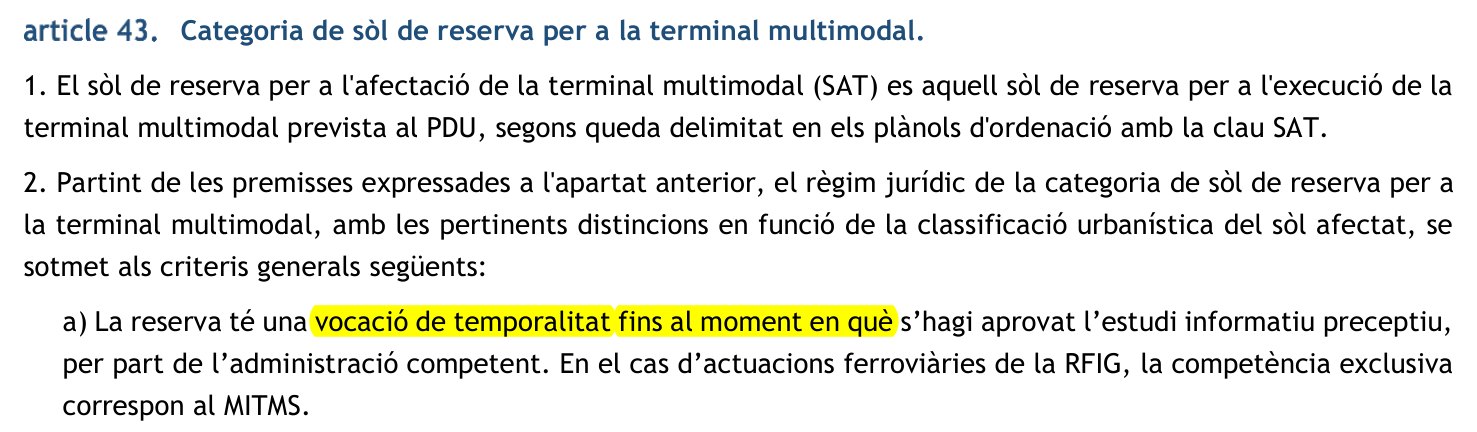
So the estate is assessed without the terminal that justifies it, and the terminal will have its own permitting process. The environmental assessment itself counts on the terminal to reduce emissions: it «juga un paper estratègic» [plays a strategic role], «amb una reducció important de GEH» [with a significant reduction in GHG]. And when it discusses the impact on the nearest settlement, it says «una avaluació específica d'aquest impacte, que s'haurà de fer en el marc de la terminal» [a specific assessment of this impact, to be carried out within the framework of the terminal] will be needed. Separating them hides the overall effect on traffic, emissions, noise and the land: no document puts it all together.
The Catalan Office for Climate Change asked for the terminal to be «prèvia o simultània a l'activitat» [prior to or simultaneous with the activity]. The approved plan only requires that, before activity begins in the giga-plot, the terminal's feasibility study be approved. An approved study is not a working terminal.
A different plan, without putting it out again
Each of these changes could be debated separately. Together they make a plan different from the one that was put out to public consultation. Torreblanca landowners could not object to cooperation because it was not there. No one could defend the public system for Limonium because its removal was not proposed. No one could comment on an estate without access from the N-240 or on a terminal taken out of the plan.
The biggest changes came when no one could say anything any more.
When a plan changes substantially after public consultation, the regulations of the Urban Planning Act require it to be put out again. This has not been done.
What the 2022 plan said and what the 2026 plan says
| Item | Put out to the public, 2022 | Approved, 2026 |
|---|---|---|
| Seveso activities | Banned in the large-plot zone; allowed in the giga-plot with measures | Allowed across the whole sector |
| Dispersion study and safety strip | No | No. Pollution and distances are decided «una per una» [one by one], in each activity's licence |
| Implementation system | Expropriation (261.4 ha) and cooperation (89.6 ha) | Cooperation (328.6 ha) |
| Cost sharing | 75 % Torreblanca and 25 % Quatre Pilans | Pending an agreement that has not been formalised |
| Protection of Limonium catalaunicum | Floral protection system, 10.2 ha publicly owned and used | Zone of areas of natural interest, in private hands |
| Action area 4 | Recovery of Limonium | Wildlife crossings |
| Climate offsetting | Articles 131 (carbon stock) and 138 (CO2 balance) | Deleted |
| Mobility manager | Article 134 | Deleted |
| Road access | C-13B and N-240 | C-13B only |
| Generated mobility | 34,771 trips/day | 34,224 trips/day |
| Intermodal terminal | Sector of the plan, 82.7 ha | Temporary reserve; to be assessed separately |
| Developable land | 351.1 ha | 328.6 ha |
- That the plan, as approved, be put out to public consultation again.
- The express exclusion of Seveso activities across the whole sector, and a dispersion and risk study before development.
- That the public protection system for Limonium and the acquisition of the land be restored.
- That the climate offsetting obligations and the mobility manager be brought back.
Associació de Veïns de l'Horta Sud de Lleida
What the plan approves and what to do if you own land
Fog, pollution and major-accident risk
The intermodal terminal
Sources: PDU for economic activity in the Plana de Lleida, document for initial approval (July 2022): urban planning regulations (articles 26, 36, 54, 55, 67, 73, 131, 134 and 138), report, technical and economic bases document and generated mobility assessment study. PDU for economic activity in the Plana de Lleida, given final approval by the Catalan Territorial Commission on 24/03/2026 and published in DOGC no. 9745, of 4/09/2026: approval decision, urban planning regulations (articles 43, 62 and 105), report, environmental document, economic and financial assessment, and generated mobility assessment study. The screenshots are from the original documents; the yellow highlighting is by the association.