
Torreblanca: who will work there, and where?
Unemployment in Lleida cannot fill the jobs promised by the Torreblanca-Quatre Pilans estate. Thousands of workers will have to be brought in from elsewhere, and the plan does not say where they will live.
Translated from the Catalan original. In case of discrepancy, the Catalan version prevails.
When the Torreblanca estate was presented in July 2022, we were promised «entre 6.000 i 12.000 llocs de treball directes qualificats» [between 6,000 and 12,000 skilled direct jobs]. The plan's mobility study, published in the DOGC on 4 September, calculates 7,306, with the gigafactory at the top of its range. But the question that matters is not how many jobs there will be, but for whom.


- 7.306
- jobs according to the plan's mobility study
- 6.435
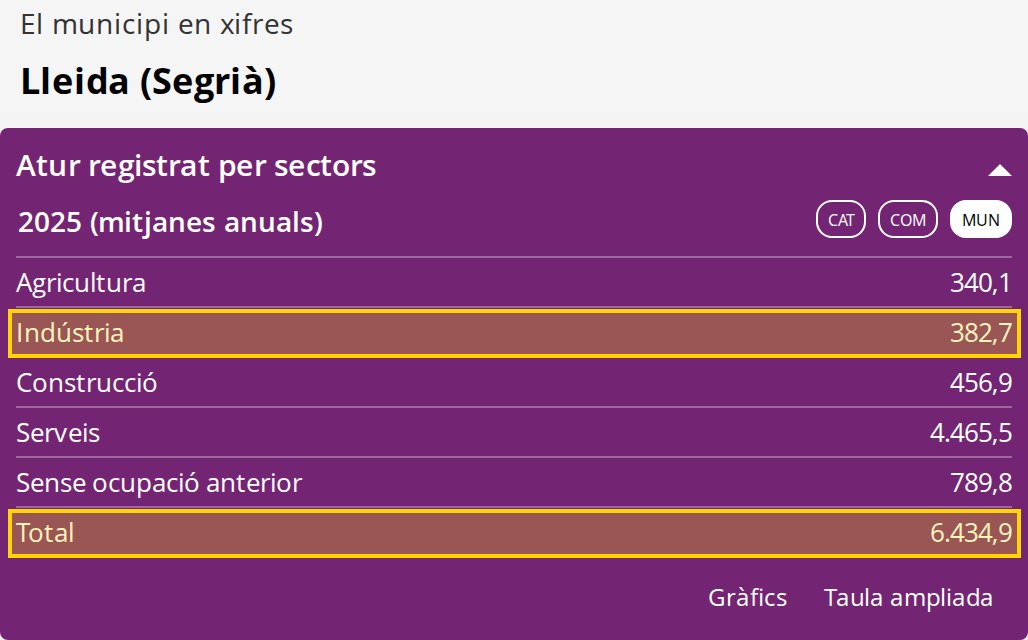
- unemployed people in Lleida (2025 average)
- 383
- of these people came from industry. The plan forecasts about 4,900 industrial jobs
- up to 8,600
- new homes needed (12,000-job scenario)
The numbers do not match local unemployment
According to Idescat, Lleida ended 2025 with an average of 6,435 people unemployed, and only 383 came from industry. The plan forecasts about 4,900 industrial jobs, gigafactory included. In the province, almost eight out of ten unemployed people have only basic education and half have been out of work for more than a year. That is hardly the profile required for «skilled» jobs.
We ran the numbers with official data and a generous assumption: that any unemployed person can fill any job. Even so, bringing unemployment in the Segrià down to 6% or 5% and drawing more people into the labour market would cover between 2,500 and 5,300 jobs. That is a ceiling, not a forecast. With the plan's figures, at least 2,000 to 4,800 workers would have to be brought in from elsewhere, and 6,700 to 9,500 if the promise of 12,000 were kept. It is not an estate designed to provide jobs for local people: it is an estate that needs to import them.
It is not an estate designed to provide jobs for local people: it is an estate that needs to import them.
And where will they live?
Many will come with their families: between 3,000 and 11,600 new residents in the official scenario, and up to 23,000 in the 12,000-job scenario. Between 1,100 and 8,600 homes that do not exist today, when Lleida's net migration is about 2,500 people a year. The plan devotes not a single line to where these people will live.
And just this summer the Generalitat removed Lleida from the list of stressed residential market areas: rent caps lapse just as demand is set to grow. Families will pay for it, as will young people who cannot afford to leave home and the incoming workers themselves, pushed into overcrowded flats.
Earning a living at home
We defend a simple idea: everyone should be able to earn a living where they come from. We want this for young people in Lleida who have to leave to find work, and for people who have to leave their country because they have no future there. The answer is not to bring workers from far away to fill warehouses, but cooperation that creates decent jobs in the countries of origin.
A model that needs to import thousands of workers is not development: it is uprooting, both here and there. Large companies benefit from cheap, precarious labour that needs proof of a job to renew residence permits and finds it harder to claim its rights. Our criticism is not aimed at those who come, who are its first victims, but at a model that uses people as a cheap resource and our land as cheap land.
Who wins
The plan reserves a 134-hectare giga-plot for a single mega-company, and in 2022 political leaders boasted of visits by delegations from the United States, South Korea and northern Europe. Large logistics warehouses are increasingly in the hands of international investment funds that buy, lease and resell with no ties to the area, often vulture funds. The profits will leave; what will remain here is more than 300 hectares of lost Horta, more lorries and a more expensive city.

- A study of the impact on population and housing before the estate is developed, with measures to absorb it.
- Local hiring and training for Lleida's unemployed.
- Guarantees that public land will not end up in speculative hands.
- Resources for cooperation that creates decent jobs in the countries of origin.
- That Lleida's removal from the stressed residential market area be reviewed.
Associació de Veïns de l'Horta Sud de Lleida
What the plan approves and what to do if you own land
Fog, pollution and major-accident risk
Sources: ACN / Lleida.com, 26/07/2022; Generated mobility assessment study of the PDUAE for the Plana de Lleida, given final approval by the Catalan Territorial Commission on 24/03/2026 and published in DOGC no. 9745, of 4/09/2026; Idescat, El municipi en xifres – Lleida; Labour Observatory, March 2026 (via Segre, 01/05/2026); 3Cat, 28/07/2026.