We want an agri-food estate, not a risk estate
The Torreblanca plan allows Seveso industries right next to Lleida, beside an oil pipeline and on a plain where fog traps whatever is emitted. And it lets each company assess the risk once it has already set up there.
Translated from the Catalan original. In case of discrepancy, the Catalan version prevails.
The plan for the Torreblanca–Quatre Pilans estate, published in the DOGC on 4 September, does not say which companies will set up there. But it does say which may: including those that European law calls Seveso, which manufacture, handle or store dangerous substances in quantities that could cause a major accident. In 2022 the regulations banned them on the large plots and only allowed them in the giga-plot. The plan approved in 2026 no longer excludes them anywhere in the sector.
The only rule it sets is article 105: they must be located at the distances set by Civil Protection and Industrial Safety «fruit de l'anàlisi específic de la determinada activitat» [as a result of the specific analysis of each particular activity]. In other words, we will look at it when they arrive.

- 0
- Seveso activities excluded: the plan allows them across the whole sector
- 1.1 km
- from the CLH hydrocarbon facility, included in the chemical emergency plan
- 420 m
- from the Mangraners school to the plots in the sector
- 127
- days of persistent fog in eight winters, at the Femosa station
A fuel pipeline right next to the sector
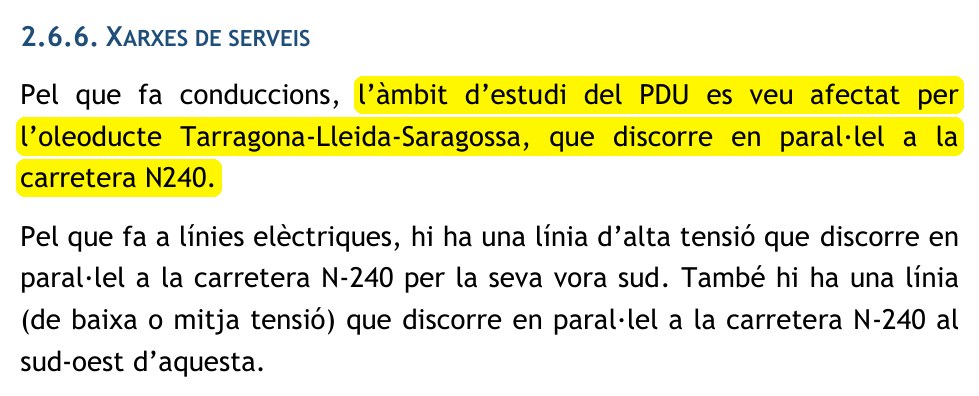
The estate is not being built just anywhere. The plan's report acknowledges that «l'àmbit d'estudi del PDU es veu afectat per l'oleoducte Tarragona-Lleida-Saragossa, que discorre en paral·lel a la carretera N240» [the PDU study area is affected by the Tarragona-Lleida-Zaragoza oil pipeline, which runs parallel to the N240 road].
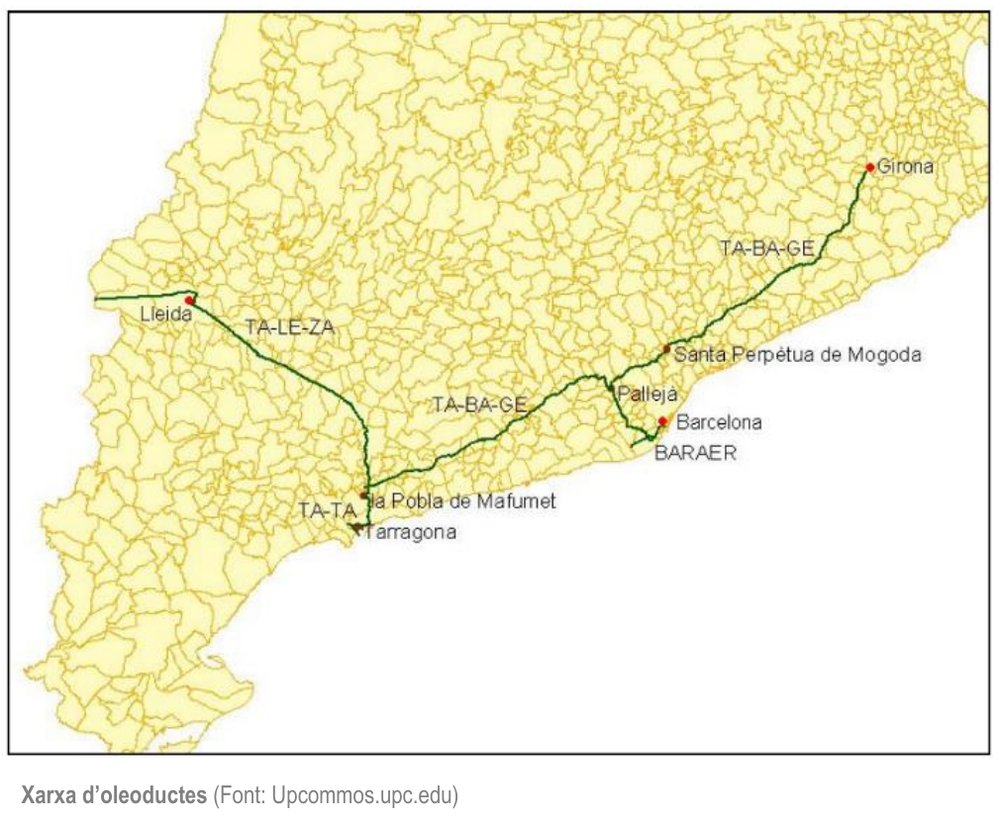
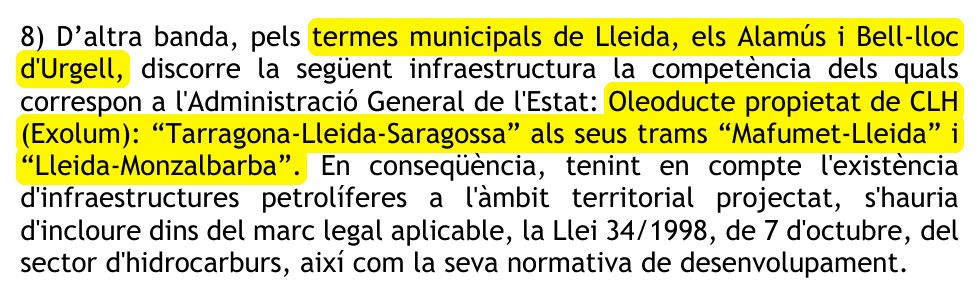
It is the Exolum (formerly CLH) pipeline, known as TALEZA. It starts at la Pobla de Mafumet, at the Tarragona petrochemical complex, reaches Lleida and continues towards Zaragoza. The Ministry report in the file places it as it passes through the municipalities of Lleida, Els Alamús and Bell-lloc d'Urgell.
The plan's own maps show it: the pipeline runs just north of the N-240 and, on the other side of the road, behind a green strip, the plots of the sector begin. Further east, at the ravine, the pipeline crosses the road and continues along the south side. The approximate route can be seen on the map in the Air and fog section.
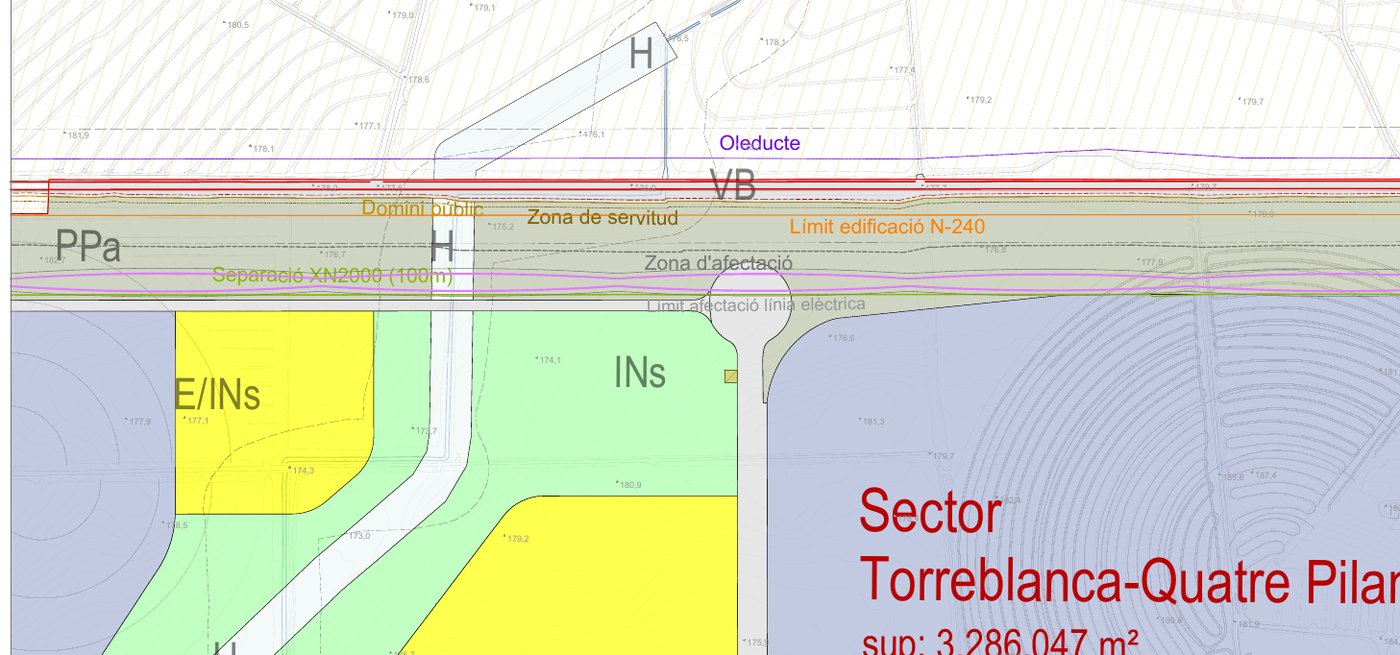
It is not the only risk element. According to the report, 1.1 kilometres from the area is the Compañía Logística de Hidrocarburos facility, the nearest establishment included in Catalonia's external emergency plan for the chemical sector. And the plan reserves land for a freight rail terminal.
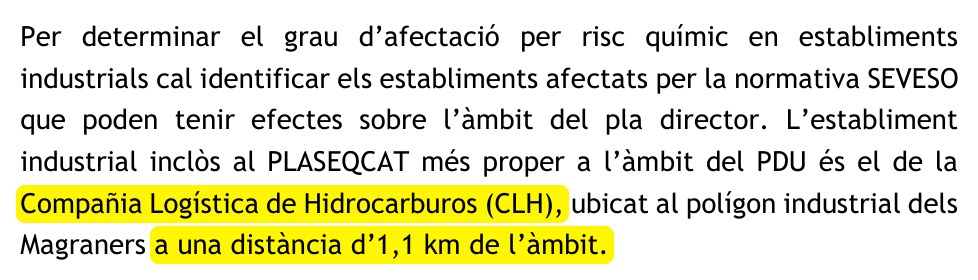
A fuel pipeline, a hydrocarbon facility one kilometre away, freight trains and, on top of that, Seveso industries across the whole sector. The scoping document for the environmental assessment asked for the maximum industrial safety strip of the estate to be drawn. The approved plan does not draw it.
Where the pollution will go
The plan describes the climate using averages. It uses a single station, Lleida-Bordeta, with data from 1997 to 2010. It says the average wind is 0.8 metres per second, almost calm, that the prevailing directions are north-east, south-west and west-north-west, and it refers to the «fenomen de la boira tan típica del Segrià» [phenomenon of the fog so typical of the Segrià].

We looked at the data from the Meteocat station at la Femosa, next to the sector. In eight winters there were 127 days of persistent fog. On those days the wind drops to 1.0 m/s and calms rise from 5 % to 17 % of the time. The most frequent winds, from the east-north-east and north-east, carry the air towards la Femosa, Vinatesa and the homes to the south-west of the sector. And 15.7 % of the time the wind blows towards the city.
Lleida's fog forms under a temperature inversion, a layer of warm air that acts as a lid over the plain. Under this lid, smoke, gases and particles build up day after day over the same fields and the same neighbourhoods. On the worst day of the last eight years, 15 December 2021, air from the estate would have passed over the city about eight times longer than on a winter day without fog.
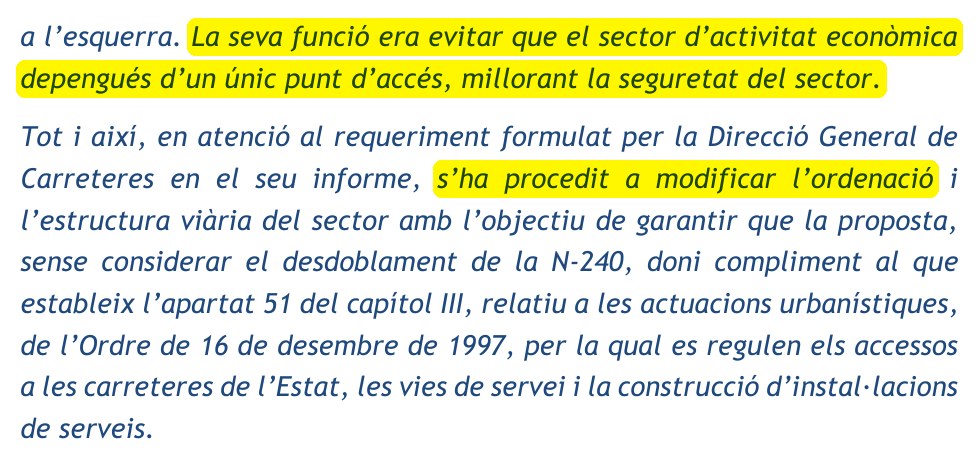
And in an accident it is worse. With little wind and stable air, a toxic cloud does not dilute: it moves along the ground. Risk analyses use a wind of 1.5 m/s as the worst case. At la Femosa, on foggy days, the wind is below that 81 % of the time. Moreover, the emergency services will only be able to enter the estate at one point. The plan has removed the N-240 access, even though it acknowledges what it was for.
See where the air from the estate would go on the worst foggy days
The risks, in the hands of the companies
The profits will go to the company; the risk, to residents, farmers and the city.
We are not the only ones to object. Unió de Pagesos asked for the admission of Seveso activities to be withdrawn because of the proximity of Mangraners and because in settings like Lleida, with temperature inversion and poor dispersion, «no seria apte una instal·lació d'aquest tipus» [a facility of this type would not be suitable]. The plan's response is this:
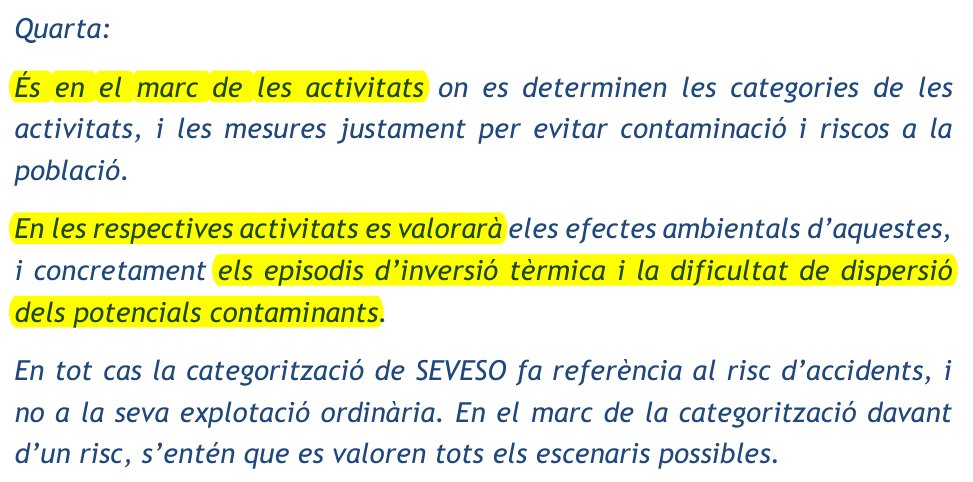
It is not an isolated sentence; it is the method. The environmental study admits that air pollution did not shape the planning, and that «seran les activitats, una per una, o si s'escau, en conjunt» [it will be the activities, one by one or, where appropriate, as a whole] that must meet the limits «en el tràmit de llicència» [at the licensing stage]. The danger zones of a Seveso establishment come from the safety report written by the company itself. And the European Seveso III Directive says that the distance between these industries and people must be decided when land is planned, which is now.
When the first company arrives, the land will already be developed and sold. The question will no longer be whether that industry should be next to Lleida, but what conditions are attached to its licence. The profits will go to the company; the risk, to residents, farmers and the city.
Why agri-food
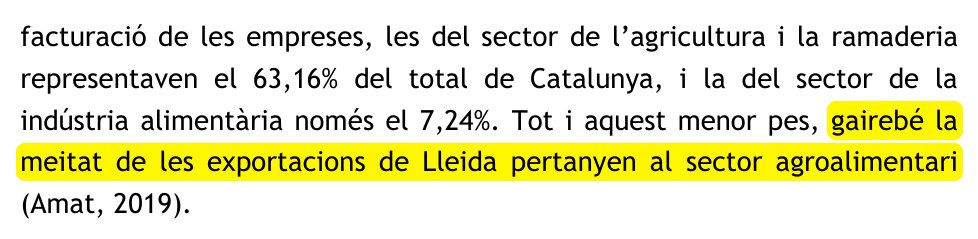
It is not only us who say so: the plan's report says it. Almost half of Lleida's exports come from the agri-food sector. And the agri-food industry, with 2 % of companies, generates 21 % of revenue. Among the territorial strategies the plan itself cites is the «Pla de promoció de Lleida com a hub agroalimentari» [Plan to promote Lleida as an agri-food hub].

- That the regulations expressly exclude Seveso activities, of any sector.
- That the land be reserved for agri-food and complementary activities, linked to the production of the Horta and the Plana.
- That the plan now draw the industrial safety strip and the zone of vulnerability that the environmental assessment asked for, taking into account the oil pipeline, the hydrocarbon facility and the rail terminal.
- An air dispersion study for the estate as a whole on days of fog and temperature inversion, before any licence is granted.
- That the second access to the sector be restored.
For all these reasons, and because of the plan's other defects, the association is taking the final approval to the High Court of Justice of Catalonia.
Associació de Veïns de l'Horta Sud de Lleida
Fog, pollution and major-accident risk
Four years to make it worse: the 2022 plan and the 2026 plan
Sources: PDUAE for the Plana de Lleida, given final approval by the Catalan Territorial Commission on 24/03/2026 and published in DOGC no. 9745, of 4/09/2026: Report (sections 2.2.5, 2.4 and 2.6.6), Urban planning regulations (art. 105), Strategic environmental study (climatology and objective 3.2), Public participation report and map O.04.b.3; Meteocat, Network of Automatic Weather Stations, Lleida – la Femosa station (YJ), half-hourly data from August 2018 to October 2026, with the methodology explained in Air and fog; Directive 2012/18/EU (Seveso III), art. 13.