
Torreblanca: the numbers depend on land at €120/m² and a terminal that still has no date
The plan can go ahead without the rail terminal being built, but the traffic calculations and much of the environmental justification count on the train as if it were already running. And the economic viability rests on selling the land at a far higher price than several public offers in Aragon.
Translated from the Catalan original. In case of discrepancy, the Catalan version prevails.
The Urban Master Plan for Economic Activity in the Plana de Lleida received final approval on 24 March 2026 and was published in the DOGC on 4 September. Since then, the debate is no longer just whether it can be processed, but whether the approved project is economically and environmentally consistent.
The official documents allow two decisive assumptions to be identified:
- that industrial land can be sold at 120 euros per square metre;
- that the future intermodal terminal will absorb a significant share of freight transport.
The problem is that the first assumption contrasts with markedly lower public prices in Aragon, and the second depends on infrastructure separate from the estate, with no firm date for entry into service.
- €120/m²
- sale price of the land that the plan takes as its central value
- €69.43/m²
- last public plot put out to tender at the Fraga logistics platform, in 2025
- €17.18m
- margin in the plan's central scenario: €5.23 per square metre
- 780
- lorries a day that the traffic study subtracts by counting on the train
Viability starts from €120/m²
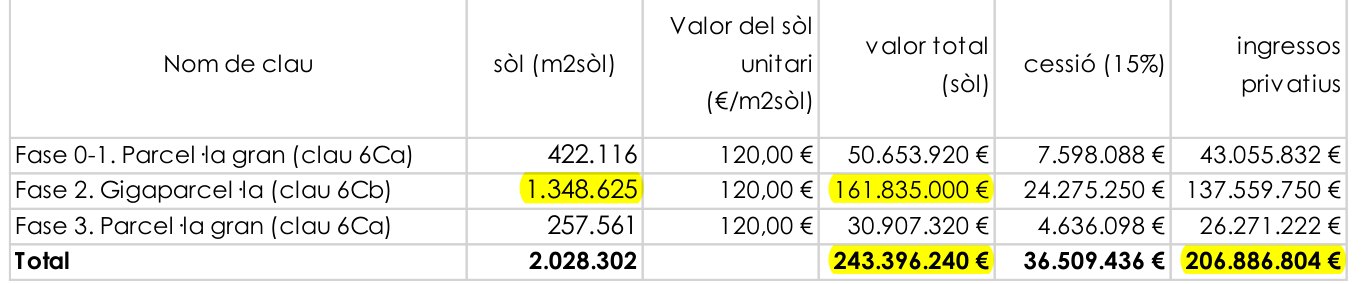
The PDU's economic assessment sets a sale range of between €115 and €125/m² and adopts €120/m² as the central value. Applied to the 1,348,625 m² of the giga-plot, this represents a gross value of €161.84 million. For all the profit-generating land, the calculated gross revenue reaches €243.40 million; after the 15 % transfer, the expected private revenue is €206.89 million.

The same study estimates total transformation costs of €163.60 million. In the central scenario, with €120/m² and a discount rate of 12.11 %, the residual value is €17.18 million, that is, €5.23/m² of gross land. Even in the best scenario analysed, with €125/m² and a rate of 10 %, the residual margin is €26.61 million.
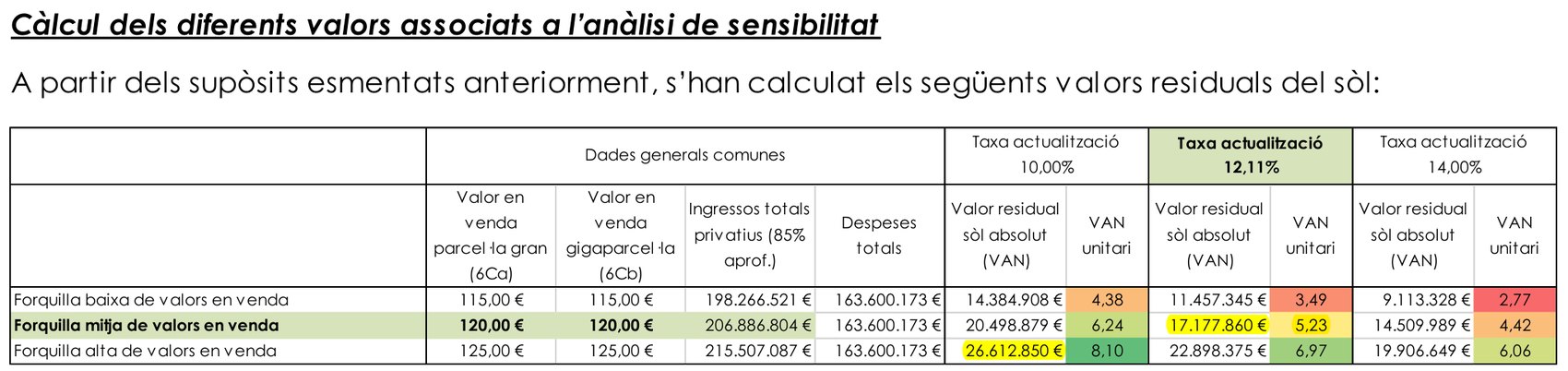
This shows that viability does not have a particularly wide cushion relative to the size of the operation. Moreover, the official analysis only tests prices between €115 and €125/m²: a variation of ten euros. It does not study any scenario with prices similar to those offered by the Aragonese public sector.
In Aragon there is public land at between €25 and €69/m²
The plots are not identical and this comparison does not replace a uniform valuation. It does, however, serve to check whether €120/m² is a prudent assumption in a market where Lleida competes directly with well-connected Aragonese platforms.
| Public offer or tender | Published price | Reference |
|---|---|---|
| PLFraga, last municipal plot of 6,750 m² | €69.43/m² | Fraga City Council tender specifications, 2025, excluding VAT |
| Villanueva de Gállego, information technology estate | from €65/m² | Suelo y Vivienda de Aragón |
| El Burgo de Ebro, El Espartal | from €55/m² | Suelo y Vivienda de Aragón |
| La Puebla de Híjar, Venta del Barro | from €27/m² | Suelo y Vivienda de Aragón |
| Caspe, El Portal | from €25/m² | Suelo y Vivienda de Aragón |
The closest reference is PLFraga, 33 kilometres from Lleida, between the A-2 and the AP-2, with services at the plot and companies in operation. In 2025, Fraga City Council valued the last available plot at €69.4313/m² before tax.
Torreblanca's €120/m² is 72.8 % higher than this reference. If, purely as a sensitivity test, the giga-plot were valued at €69.43/m² and all the PDU's other assumptions were kept, private revenue would fall by roughly €58 million. This reduction is far greater than the residual value of €17.18 million in the official central scenario.
We are not saying that Torreblanca must be sold at exactly the Fraga price. What we are saying is that an operation of this size needs a much more demanding sensitivity analysis than the €115 to €125/m² range used by the PDU.
The budget already schedules €53.4 million of Incasòl investment
The annex of real investments in the Generalitat's budgets for 2026–2029 contains three lines specific to Torreblanca–Quatre Pilans: acquisitions, expenses and development works. Together they total €53,408,904:
| Year | Scheduled amount |
|---|---|
| 2026 | 3.611.815 € |
| 2027 | 10.829.514 € |
| 2028 | 18.288.105 € |
| 2029 | 20.679.470 € |
| Total 2026–2029 | €53,408,904 |
This amount is Incasòl's scheduled investment, not necessarily a lost public subsidy: the cooperation system charges development costs to landowners and part of the investment can be recovered. But it does show the amount of public capital planned to be mobilised and the timing risk the acting authority takes on before the actual sales results are known.
On top of this there is separate rail infrastructure. In 2022 the terminal was a sector of the same plan, of 82.7 hectares; the plan approved in 2026 only reserves land for it and leaves it to a separate permitting process. In 2025 the Generalitat put the cost of building the Plana de Lleida terminal at €131 million, with a model that will have to combine public and private resources. The two figures should not be added mechanically as if they were the same expenditure, but nor can the estate be presented as an operation detached from the public effort needed for its logistics and environmental narrative to work.
The PDU does not require the terminal to be built
The approved rule is clear. In the giga-plot no economic activities may begin until the feasibility study for the intermodal terminal has been approved. It does not say that the terminal must be built, connected to the network or in service.

So this condition does not, on its own, prevent reparcelling, development or building from going ahead. It only prevents economic activity in the giga-plot from starting until an administrative document is approved.
The condition comes from the strategic environmental statement, which justifies it by the environmental and climate benefits of moving freight from road to rail.
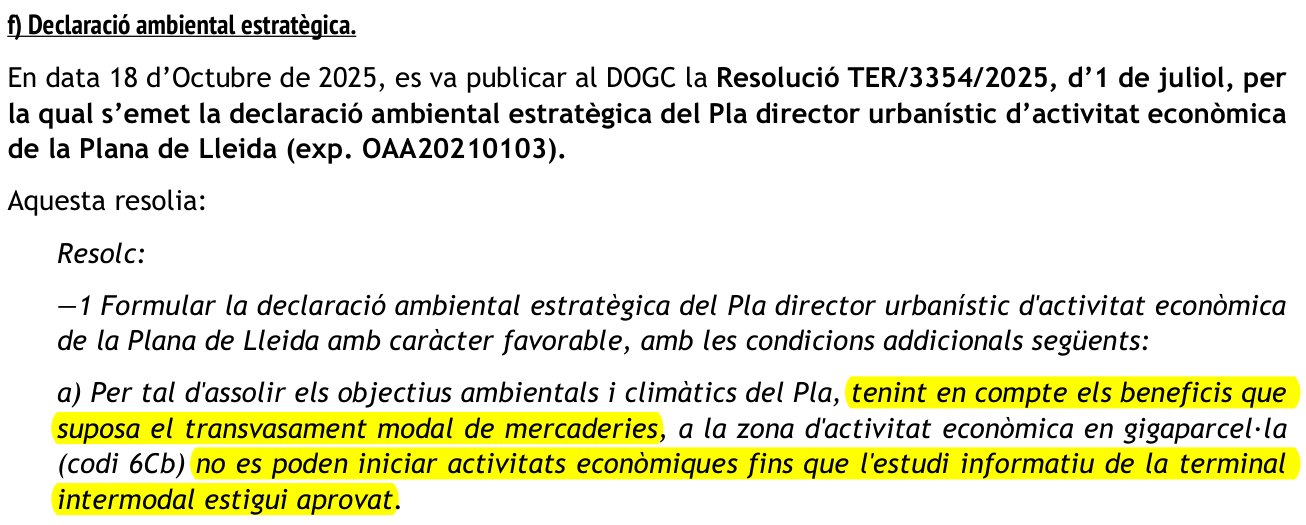
This is where the main contradiction appears: approving the feasibility study does not move a single lorry onto the train. For the environmental benefit to happen, the terminal has to be designed, funded, built, connected and operated with enough rail demand.
That is why the Catalan Office for Climate Change asked for the terminal to be «prèvia o simultània a l'activitat» [prior to or simultaneous with the activity], as we explained when comparing the 2022 plan with the 2026 plan. The approved plan has stopped at the study.
The traffic calculations already subtract 780 lorries a day
The mobility study calculates 13,543 daily heavy-vehicle movements. It then applies a rail share of 11.5 % and subtracts 780 lorries a day, so the figure falls to 12,763.
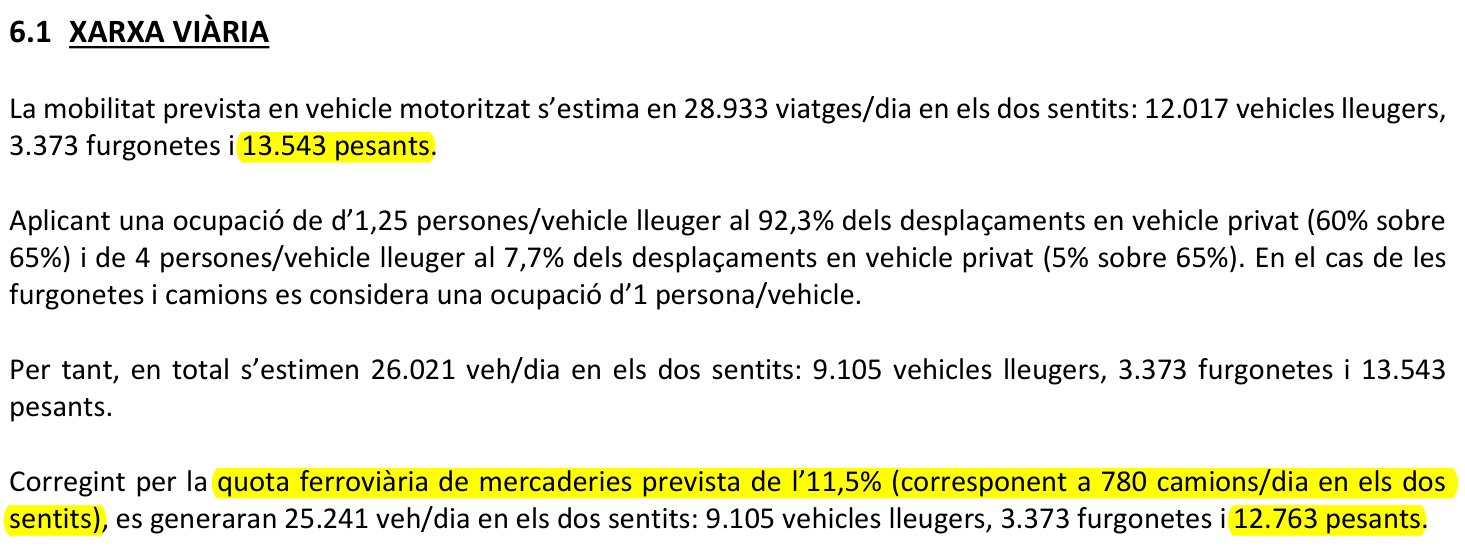
This reduction only exists if there is a working terminal. If the estate and its activities move ahead of the railway, during that interval the road network will have to absorb the lorries the study has already discounted. The same gap affects emissions: the environmental benefits attributed to the modal shift do not materialise with the approval of a study.
From works announced for 2027 to the 2031 target
In March 2025 the Generalitat put the terminal's feasibility study out to public consultation. It expected to give final approval in December 2025 and to start works in 2027. These were forecasts, not a tender or a contractual date.
On 15 September 2026 the Catalan Government approved the Catalan rail terminal strategy 2026–2036. It provides €127 million up to 2031 for four terminals, which, at least in a first phase, should be operating that year. Lleida's is the most advanced and receives €72 million for construction. But it is a planning target, not a works schedule: the works still have to be put out to tender, and the €72 million falls short of the €131 million the Generalitat estimated in 2025. None of the sources consulted explains the difference between the two figures.
Almost a year after the expected date, in the official sources consulted we have not found any resolution giving final approval to the feasibility study, nor any contractual schedule for construction and entry into service. Meanwhile, Incasòl's budget already schedules the Torreblanca development works up to 2029.
This is the gap that needs explaining: an estate that can move ahead legally with a terminal still on paper, but that needs this terminal up and running for the traffic, emissions and logistics-appeal calculations to add up.
A giga-plot with no identified company
The approved documents define a giga-plot of 134.9 hectares and calculate the economic scenario as if it were sold at €120/m², but they do not identify any buyer or any firm employment commitment.
The mobility study estimates 7,306 jobs for the sector as a whole. If a large part of this labour demand has to be met by people from elsewhere, the impact on housing and services in Lleida is not a secondary issue. The PDU includes no housing programme linked to this potential arrival of workers.
So, before committing more resources, at least the following information would be needed:
- A viability analysis with comparable prices from Lleida, Fraga and other Aragonese estates.
- An economic scenario with the giga-plot below €115/m².
- A public, funded and coordinated timetable for the rail terminal.
- An assessment of traffic and emissions for the years in which the estate may operate without a terminal.
- Information on real business commitments, expected employment and housing and service needs.
Conclusion
Torreblanca does not fail because the terminal is unnecessary, but precisely because it needs it more than the rules require. The PDU allows the giga-plot to be unlocked with the approval of a study, while its logistics and environmental benefits require a terminal that is built and operational.
At the same time, economic viability rests on selling an extraordinary volume of land at €120/m², when in Aragon there are public offers between €25 and €65/m² and the last PLFraga tender came out at €69.43/m².
These are not minor differences. They are the two assumptions that hold the project up. And until there is a solid answer on the real market price, the terminal, the timetable and business demand, the Torreblanca numbers will still not add up.
Associació de Veïns de l'Horta Sud de Lleida
The intermodal terminal: what has been published
Four years to make it worse: the 2022 plan and the 2026 plan
Torreblanca: who will work there, and where will they live?
Sources: PDUAE for the Plana de Lleida, given final approval by the Catalan Territorial Commission on 24/03/2026 and published in DOGC no. 9745, of 4/09/2026: approval decision of the Territorial Commission (report from the Catalan Office for Climate Change), Urban planning regulations (arts. 43 and 62.9), Economic and financial assessment (sections 11 and 14), Generated mobility assessment study (section 6.1) and Environmental document, report (strategic environmental statement, Resolution TER/3354/2025); Generalitat de Catalunya, presentation of the feasibility study for the Plana de Lleida rail terminal (March 2025), PDU page and Plana de Lleida intermodal freight station; Catalan Government press release, 19/03/2025; CIMALSA, Catalan rail terminal strategy 2026–2036 (15/09/2026); VIA Empresa, Segre and Nació Digital, 15/09/2026; Generalitat 2026 budget, annex of real investments, project 03-01911, Torre Blanca–Quatre Pilans; Fraga City Council, tender specifications for plot LIE-2-04 at PLFraga (2025), unit value €69.4313/m²; Aragón Plataforma Logística, PLFraga page; Suelo y Vivienda de Aragón, public supply of industrial land. Information consulted up to 1 November 2026. The price comparisons are indicative and do not replace a uniform valuation of the plots.